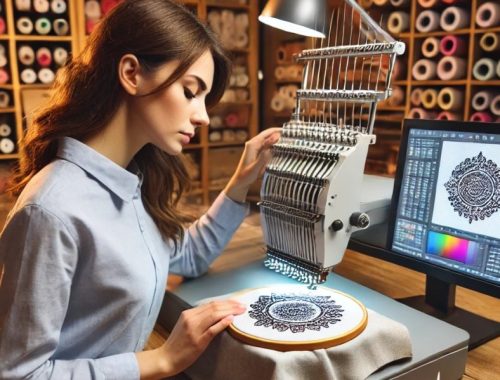
Professional Embroidery Digitizing Services in USA for Small Businesses
Introduction: Why Your Small Business Needs Help with Embroidery Files
You started your small business because you love making things. Maybe you sell custom hats at local markets. Maybe you monogram towels for bridal parties. Or maybe you stitch logos onto uniforms for a youth soccer league. Whatever you make, you hit a wall when the embroidery machine refuses to cooperate. That cute coffee shop logo looks perfect on your screen but stitches out like a blob. The letters touch each other. The details disappear. You waste thread, ruin fabric, and stay up way too late watching YouTube tutorials that do not help. Here is the truth: you do not have to figure this out alone. Embroidery Digitizing Services exist exactly for people like you.
I remember when I first tried to digitize my own logo. A simple circle with three stars and some text. I spent eight hours. Eight. I watched seventeen videos. I tried three different software programs. The final result still looked like a toddler drew it with a crayon while riding a bumpy bus. That is when I finally swallowed my pride and hired a professional digitizer. Best decision I ever made. The file worked perfectly on the first try. My machine ran smooth. The logo looked crisp and professional. And I got back those eight hours to actually run my business.
Small business owners like us wear too many hats already. You are the marketer, the accountant, the shipper, and the customer service rep. Do you really want to add professional digitizer to that list? Probably not. So let me walk you through exactly how professional embroidery digitizing services in the USA work, why they are worth every penny, and how to find the right one for your small business.
What Exactly Is Embroidery Digitizing?
Let me clear up a huge misunderstanding. Digitizing is not the same as converting. When you use a simple image converter, the software just guesses where to put stitches. It is like asking a random stranger to trace your drawing without any instructions. Sometimes it works okay. Most times it does not.
Professional digitizing is completely different. A real human being opens your logo in specialized software. They look at every single detail. They decide exactly where each needle puncture goes. They choose stitch types, angles, densities, and underlay. They set color changes and trim commands. They test the file virtually and fix problems before you ever see it.
Think of it this way. A basic converter gives you a coloring book. A professional digitizer gives you a paint-by-number with the brushes included. Both get you from start to finish, but one saves you a whole lot of frustration.
Why USA-Based Services Matter for Small Businesses
You can find digitizing services on Fiverr for three dollars. I am not kidding. Three dollars for a logo file. And those services are almost always overseas. They work fast because they have to do high volume to make any money. Quality suffers. Communication suffers. And when something goes wrong, good luck getting a revision.
USA-based digitizing services cost more. Expect fifteen to forty dollars per logo depending on size and complexity. But here is what that extra money buys you. First, you get someone who speaks your language fluently. No translation confusion about stitch directions or color orders. Second, you get someone who understands American business hours. You email a problem at 9 AM, you get a response by lunch. Third, you get someone who knows the machines you actually use. Brother, Baby Lock, Janome, Melco. They have tested files on those exact machines.
For a small business, time is money. Waiting three days for an overseas digitizer to respond to a simple question costs you more than the fifteen dollars you saved. I learned this the hard way when a three-dollar digitizer sent me a file that stitched the letters of my business name backwards. Backwards. I had to throw away eight hats. Never again.
What a Professional Digitizer Does That Software Cannot
Let me give you a real example. Imagine your logo has a thin banner with small text. You run it through an automatic converter. The software sees the banner as one big shape and the text as another big shape. It stitches the banner, then tries to stitch the text on top. But the text stitches are too dense, so they punch holes through the banner fabric. The letters look like they are drowning.
A professional digitizer solves this. They split the text into individual letters. They add a special underlay stitch that stabilizes the fabric before the top stitches go down. They reduce the density on the small letters so the needle does not tear through. They even add a tiny pull compensation so the letters do not squish together. The result? Clean, readable text that looks like it was painted on.
Here is another example. Your logo has a gradient. One color fades into another. An automatic converter has no idea what to do with a gradient. It just picks two colors and calls it a day. A professional digitizer creates a technique called tatami blending. They use different stitch directions and densities to create the illusion of fading. It takes skill and experience. No software in the world does this automatically.
How to Find the Right Digitizing Service for Your Small Business
Not all digitizing services are created equal. Here is exactly how to vet them.
First, ask for samples. A good service will have a portfolio of before-and-after images. Look for logos with small text, thin lines, and detailed shapes. If those look crisp, the digitizer knows what they are doing.
Second, ask about turnaround time. For most small business logos, two to four hours is reasonable. Overnight is fine too. But if they promise fifteen minutes for a complex logo, run away. That means they are using automation and calling it manual.
Third, ask about revisions. The best services offer free revisions until you are happy. Because here is the truth. Even professional digitizers sometimes need to tweak a file after you run a test on your specific machine. Your fabric type, your thread brand, your hoop tension. Those variables matter. A good service works with you until the file stitches perfectly on your machine, in your shop, with your materials.
Fourth, ask about file formats. You need PES for most Brother and Baby Lock machines. But maybe you also need DST for a commercial Tajima machine. Or CND for Melco. A professional service provides any format you want at no extra charge.
The Real Cost of Bad Digitizing for Your Business
Let me do some small business math with you. You sell custom hats at twenty dollars each. Your cost for the hat is five dollars. Your labor is three dollars. Your profit per hat is twelve dollars. Now imagine a bad digitizing file ruins ten hats. You lose fifty dollars in materials and thirty dollars in labor. Plus you lose the eighty dollars in sales you would have made. That is one hundred sixty dollars gone. All because you tried to save twenty bucks on digitizing.
Bad digitizing hurts your reputation too. A customer orders five hoodies with their family farm logo. The letters come out crooked. The animal looks like a weird blob. They return the hoodies. They leave a bad review. They tell their friends. That damage lasts way longer than the money you saved.
Professional digitizing is not an expense. It is an investment in consistency, quality, and your brand’s reputation.
When to Use a Service vs. When to DIY
Here is my honest advice. If you make fewer than fifty embroidered items per month, you can probably learn to digitize simple designs yourself. Use beginner software like SewArt or Embrilliance. Stick to bold shapes, large text, and simple logos. You will make mistakes, but that is how you learn.
If you make more than fifty items per month, or if your logos have small text, fine details, or gradients, hire a professional. Your time is worth more than the learning curve. Focus on running your business and satisfying your customers. Let the digitizers do what they do best.
I still digitize some of my own designs. Simple monograms, basic shapes, one-color logos. But anything with my business name or detailed artwork goes straight to my trusted digitizer. That boundary keeps me sane and my customers happy.
Conclusion: Stop Struggling and Start Stitching
You did not start your small business to become an embroidery software expert. You started it to create beautiful products that make people smile. Professional embroidery digitizing services take the technical headache off your plate. They turn your logo into a perfect stitch file. They save you hours of frustration and pounds of wasted thread. They protect your reputation and grow your business.
So here is your action plan. Find two or three USA-based digitizing services. Send them your logo. Ask for samples and pricing. Pick the one that communicates clearly and shows you real results. Run a test stitch on your machine. And then get back to doing what you love: making awesome stuff for your customers.
Your machine is ready. Your thread is waiting. Go make something great.