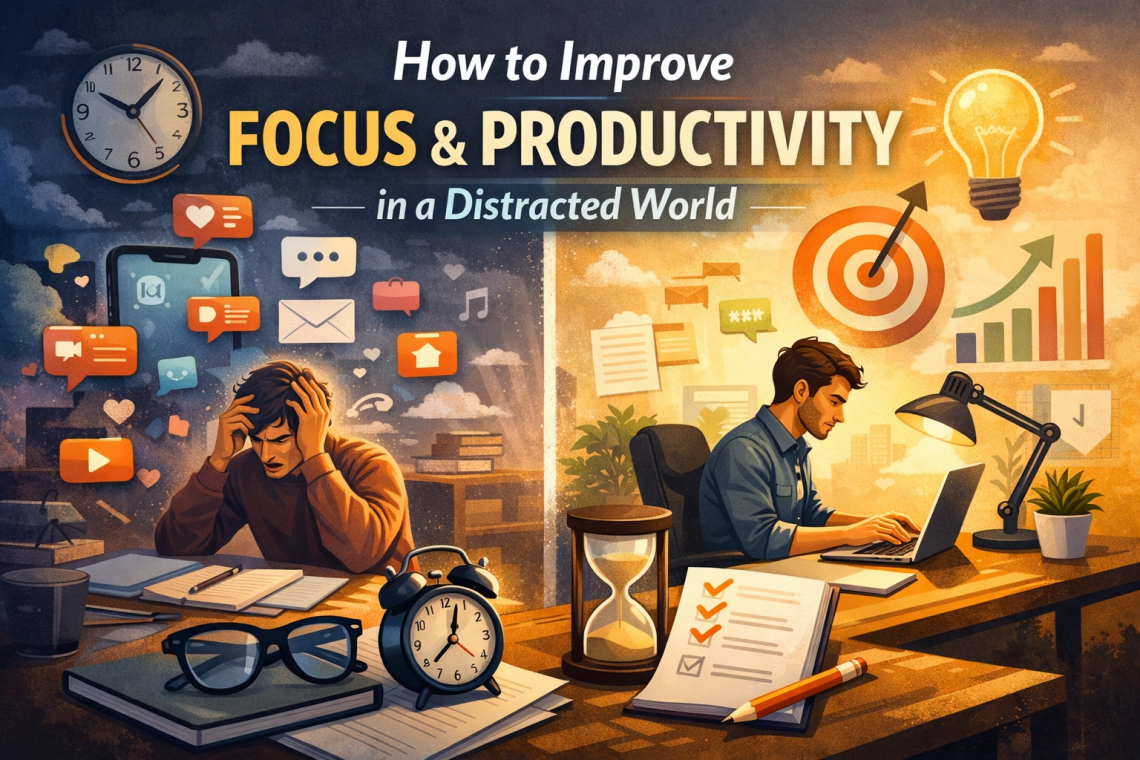
How to Improve Focus and Productivity in a Distracted World
In today’s hyper-connected world, staying focused feels harder than ever. Notifications constantly compete for attention, social media is engineered to keep you scrolling, and multitasking has become the default way of working. As a result, many people struggle to complete important tasks, meet deadlines, or simply think deeply without interruption.
Learning how to improve focus and productivity in a distracted world is no longer just a personal development goal; it’s a necessity for success in work, studies, and even personal life. The good news is that focus is not something you either “have” or “don’t have.” It is a trainable skill that can be strengthened with the right habits, environment, and mindset.
In this guide, we will break down practical, science-backed strategies to help you regain control of your attention and dramatically improve your productivity.
Why Focus Has Become So Difficult Today
Modern distractions are not accidental; they are designed to capture your attention.
Every app, website, and platform competes for one thing: your time. Social media platforms use algorithms that trigger dopamine responses, keeping you engaged longer than intended. Emails, messages, and notifications create a constant sense of urgency, making it difficult to stay in deep work.
Some of the biggest distractions include:
- Smartphone notifications
- Social media apps (Instagram, TikTok, Facebook, etc.)
- Constant email checking
- Open-office environments
- Multitasking habits
- Mental overload from too many tasks
The human brain is not designed for constant task-switching. Every time you shift your attention, you lose mental energy and reduce efficiency.
The Science Behind Focus and Productivity
To improve focus, it helps to understand how your brain works.
1. Attention Residue
When you switch from one task to another, part of your attention stays stuck on the previous task. This is known as “attention residue,” and it reduces your ability to fully concentrate on the new task.
2. Dopamine Loops
Digital apps are designed to trigger dopamine releases, small hits of pleasure that make you want to keep scrolling or clicking.
3. Cognitive Load
Your brain has a limited mental capacity. The more tasks you try to juggle, the more overloaded it becomes, leading to mistakes and fatigue.
Understanding these mechanisms is the first step toward building better focus habits.
The Foundation of Productivity: A Focus-Friendly Environment
Before learning techniques, you must design an environment that supports focus instead of breaking it.
Remove Digital Distractions
- Turn off non-essential notifications
- Keep your phone in another room while working
- Use “Do Not Disturb” mode during deep work sessions
Organize Your Workspace
A cluttered environment leads to a cluttered mind. Keep only essential items on your desk.
Use Website Blockers
Tools like focus apps or browser extensions can limit access to distracting websites during work hours.
A distraction-free environment reduces the need for constant willpower.
Time Blocking: Structuring Your Day for Maximum Output
Time blocking is one of the most effective productivity strategies used by high performers.
Instead of working randomly, you assign specific time slots for tasks.
Example of Time Blocking:
- 9:00 – 11:00 → Deep Work (important task)
- 11:00 – 11:30 → Emails/messages
- 11:30 – 1:00 → Project work
- 2:00 – 3:00 → Meetings or admin tasks
This method reduces decision fatigue and ensures that important work gets done first.
The Power of Deep Work
Deep work is the ability to focus without distraction on a cognitively demanding task. It is one of the most valuable skills in the modern economy.
To practice deep work:
- Work in 60–90 minute focused sessions
- Eliminate all interruptions during this time
- Set a clear goal for each session
- Take short breaks between sessions
Even 2–3 hours of deep work per day can produce better results than 8 hours of distracted work.
Use the Pomodoro Technique for Better Focus
The Pomodoro Technique is a simple yet powerful productivity method:
- Work for 25 minutes
- Take a 5-minute break
- Repeat 4 cycles
- Take a longer break (15–30 minutes)
This method works because it aligns with your brain’s natural attention span and prevents burnout.
Train Your Mind with Single-Tasking
Multitasking is a productivity myth. In reality, it reduces efficiency by up to 40%.
Instead, focus on one task at a time.
How to practice single-tasking:
- Write down one priority task each day
- Finish it before moving to another task
- Avoid switching tabs or apps unnecessarily
Single-tasking improves both speed and quality of work.
Build Better Habits for Long-Term Focus
Improving productivity is not about short-term hacks; it’s about building sustainable habits.
Morning Routine Matters
Start your day without distractions:
- Avoid checking your phone immediately
- Plan your top 3 tasks for the day
- Start with the most important task
Habit Stacking
Attach new habits to existing ones:
- After coffee → 30 minutes of focused work
- After lunch → quick review of tasks
Small habits compound into major productivity improvements over time.
The Role of Sleep, Diet, and Exercise
Your physical health directly impacts your mental performance.
Sleep
Poor sleep reduces attention span, memory, and decision-making ability.
Diet
Avoid heavy sugar intake and processed foods that cause energy crashes.
Exercise
Even 20–30 minutes of daily movement improves brain function and focus.
A healthy body supports a sharp and productive mind.
Digital Detox: Reclaiming Your Attention
A digital detox helps reset your brain from constant stimulation.
Try this:
- No social media for 24 hours per week
- No phone during meals
- One hour screen-free before bed
You’ll notice improved clarity, reduced stress, and better concentration.
Productivity Tools That Actually Help
Instead of relying on willpower alone, use tools to stay organized:
- Task managers (to-do lists)
- Calendar apps for scheduling
- Focus timers for structured work sessions
- Note-taking apps for ideas
However, avoid overloading yourself with too many tools. Simplicity is key.
Common Mistakes That Kill Productivity
Many people struggle with focus because of avoidable mistakes:
- Starting the day without a plan
- Constantly checking emails
- Overloading tasks in one day
- Working without breaks
- Trying to multitask everything
Avoiding these mistakes alone can significantly boost your productivity.
A Simple Daily Routine for Maximum Focus
Here’s a practical routine you can follow:
Morning:
- Wake up and avoid the phone for 30 minutes
- Plan the top 3 priorities
- Start a deep work session
Today:
- Handle emails and communication
- Short break or walk
- Second focused work block
Evening:
- Light tasks or review work
- Plan the next day
- Digital wind-down before sleep
Consistency is more important than perfection.
Final Thoughts
In a world full of distractions, focus has become one of the most valuable skills you can develop. The ability to control your attention directly impacts your success, productivity, and even mental well-being.
By applying strategies like deep work, time blocking, single-tasking, and digital detoxing, you can significantly improve your ability to concentrate and get meaningful work done.
At the end of the day, productivity is not about doing more; it’s about doing what matters most with full attention and intention.
For more insights and practical digital growth strategies, platforms like WellUdigital continue to share useful resources to help individuals and businesses thrive in a distracted world.

Anda Mungkin Suka Juga

BRI Bintaro Gelar Car Free Day, Hadirkan Olahraga dan Edukasi Perbankan untuk Masyarakat

Ratusan Personel Polresta Sidoarjo Berjibaku Bersihkan Puing Bangunan Ponpes Al Khoziny